A wine cooler does a quieter job than a refrigerator, but a more exact one. Wine does not need to be cold; it needs to be steady. A few degrees of drift, day after day, ages a bottle faster than you want. Appliance Repair Doctors examine wine coolers, wine refrigerators and beverage centers, find out why the temperature moves, and fix the part that is causing it. Our wine cooler house calls cover Atlanta and the towns around it.
Call (470) 570-7920 or send the form on this page. Tell us the brand, whether the cooler is built in or freestanding, and what it is doing.
Choose the appliance, then enter a 5-digit ZIP code to see if we come to your area.
Choose your appliance to see how the Doctors diagnose and repair it.
Not cooling, leaking water, ice maker down or a strange noise.
Frost buildup, food softening or a freezer that runs nonstop.
No ice, slow ice or a leak from the dispenser.
Wine coolers and beverage centers that run warm.
Gas and electric ovens that will not heat or bake evenly.
Burners, cooktops and ranges: gas, electric and induction.
1. Real temperatures in each zone. We measure inside the cabinet, not just on the display, and compare each zone with its setting.
2. Cooling type. A compressor cooler works like a small refrigerator. A thermoelectric cooler has no compressor; it uses a solid-state module with fans. They fail in different ways, so the exam is different.
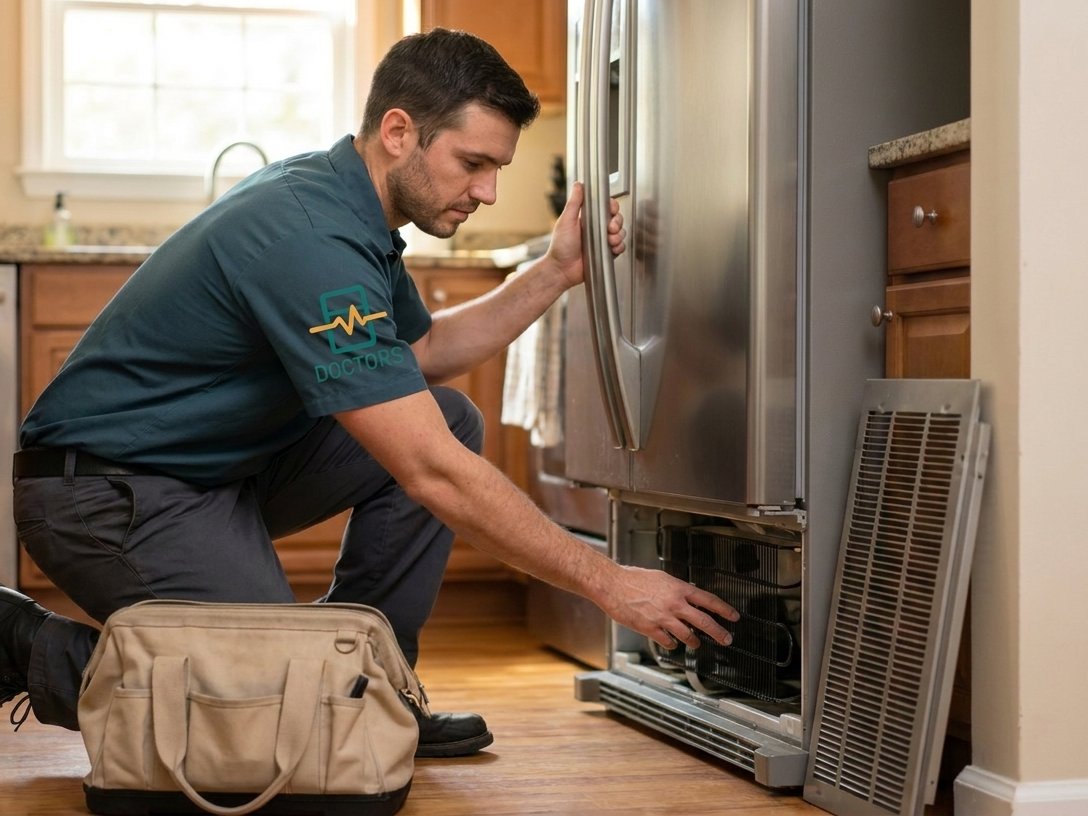
3. Airflow and ventilation. Built-in coolers breathe through the front grille at the bottom. We check that the grille is clear and that the fans turn.
4. Condenser and compressor, on compressor models.
5. Controls and sensors for each zone.
6. Door, gasket and hinges. We check the seal and the glass door for proper closing.
Then we explain the diagnosis and the repair before any work starts.
Brands we service include Sub-Zero, Viking, Marvel, U-Line, Perlick, Fisher & Paykel, Bosch, Thermador, Monogram, Dacor, KitchenAid, Frigidaire and others. We are an independent repair company, not affiliated with any wine cooler manufacturer.
We use genuine or OEM-approved parts. Every repair carries our warranty of up to 6 months on parts and labor, and up to 12 months on Sub-Zero.
Many wine makers and appliance makers use about 55°F as a long-term storage temperature for wine. Serving temperatures vary: whites and sparkling wines are usually served colder than reds. A dual-zone cooler lets you keep one zone for storage and the other near the serving temperature of what you drink most. What matters most for the wine is that the temperature stays steady.
Built-in and full-size wine coolers are almost always worth repairing; fans, controls, gaskets and start parts are replaceable. Small thermoelectric countertop coolers are the exception: a failed module can be close to the value of the cooler. We tell you which case you are in after the exam.
Single-zone coolers keep the whole cabinet at one temperature. They are simple, and when they fail it is usually the fan, the sensor or the cooling system.
Dual-zone coolers keep two sections at different temperatures, often one for whites and one for reds, or one for storage and one for serving. Each zone has its own sensor, and many have their own fan and air damper. When one zone drifts and the other holds, the exam focuses on that zone's parts.
Wine columns and tall units can have three or more zones, or combine wine storage with refrigerator drawers. They work like built-in refrigerators and are repaired the same way, with extra attention to zone controls.
Vibration matters more in a wine cooler than in a refrigerator. Many wine coolers are designed to keep vibration low, with quiet fans and compressors mounted on soft supports. If your cooler starts to hum louder, rattle or shake the bottles, a fan motor may be wearing out, a panel may be loose, or a compressor mount may have broken. We find the source and fix it, so the bottles can rest undisturbed.
Wine stored for years needs some humidity so corks do not dry out. Built-in wine storage is designed to hold humidity inside the cabinet. A cooler that suddenly shows water pooling on the floor, or one that looks completely dry, may have a drain or seal problem. Tell us what you see; it is part of the exam.
An under-counter cooler sits inside cabinetry, so it takes in and pushes out air through the grille at the front. Built-in models are designed for that. A freestanding cooler pushed into a cabinet opening is not, and it can overheat and stop cooling. If your cooler was installed recently, tell us whether it is a built-in or freestanding model.
Call (470) 570-7920 or send the form with the brand and symptoms, and we will call you back to set a time.
A dusty condenser, a failed fan, a weak seal or a control that no longer reads the right temperature.
Dual-zone coolers have separate controls and sometimes separate fans; one of them has failed.
The defrost cycle or the drain is not working, or the door has been sealing poorly.
A clogged drain line or a drain pan out of place.
Vibration is bad for wine. A worn fan motor, a loose panel or a compressor mount may be the cause.
Heat is not leaving: the vents are blocked, the condenser is dirty, or the room is too warm for the unit.
A control board, a power supply or a door switch.
A torn gasket, a sagging hinge or a cabinet out of level.
The cooling module or its fans have failed.
Appliance Repair Doctors is a family-owned company. Office: 4370 Peachtree Rd NE, Brookhaven, GA 30319.
The most common causes are a dirty condenser or blocked grille, a failed fan, a worn door gasket and a faulty temperature sensor. Our exam checks each one.
Yes. We check the cooling module and its fans; for small countertop units we tell you honestly if repair makes sense.
Yes, including under-counter coolers, full-size wine columns and beverage centers.
Only if the manual allows the temperatures your garage reaches. Many coolers are made for indoor rooms and struggle in heat.
Yes. Up to 6 months on parts and labor, and up to 12 months on Sub-Zero.
A fan motor wearing out, a loose panel or a broken compressor mount are the usual causes. We find the source and fix it.
Only if the manual says it is designed for that. Freestanding models need open space around them; built-in models breathe through the front.
The display shows the setting or a sensor reading. We measure the real temperature in each zone to see whether a sensor is off.
Freezer Repair Ice Maker Repair Oven Repair Refrigerator Repair Stove & Range Repair Wine Cooler Repair
Call Appliance Repair Doctors: (470) 570-7920
Call the Doctors — (470) 570-7920 Or request a callback