A refrigerator rarely fails all at once. It gives small signs first: a soft hum that turns into a buzz, milk that goes off a day early, a thin line of water under the crisper drawer. By the time most people call, the fridge has been sick for a while. Appliance Repair Doctors treat that the way a good doctor treats a patient. We examine the whole system, name the cause, and only then replace a part. Our refrigerator house calls cover Atlanta and the towns around it.
Call (470) 570-7920 or send the form on this page. Tell us the brand, what the refrigerator is doing and your ZIP code, and we will offer a visit window, usually same- or next-day.
Choose the appliance, then enter a 5-digit ZIP code to see if we come to your area.
Choose your appliance to see how the Doctors diagnose and repair it.
Not cooling, leaking water, ice maker down or a strange noise.
Frost buildup, food softening or a freezer that runs nonstop.
No ice, slow ice or a leak from the dispenser.
Wine coolers and beverage centers that run warm.
Gas and electric ovens that will not heat or bake evenly.
Burners, cooktops and ranges: gas, electric and induction.
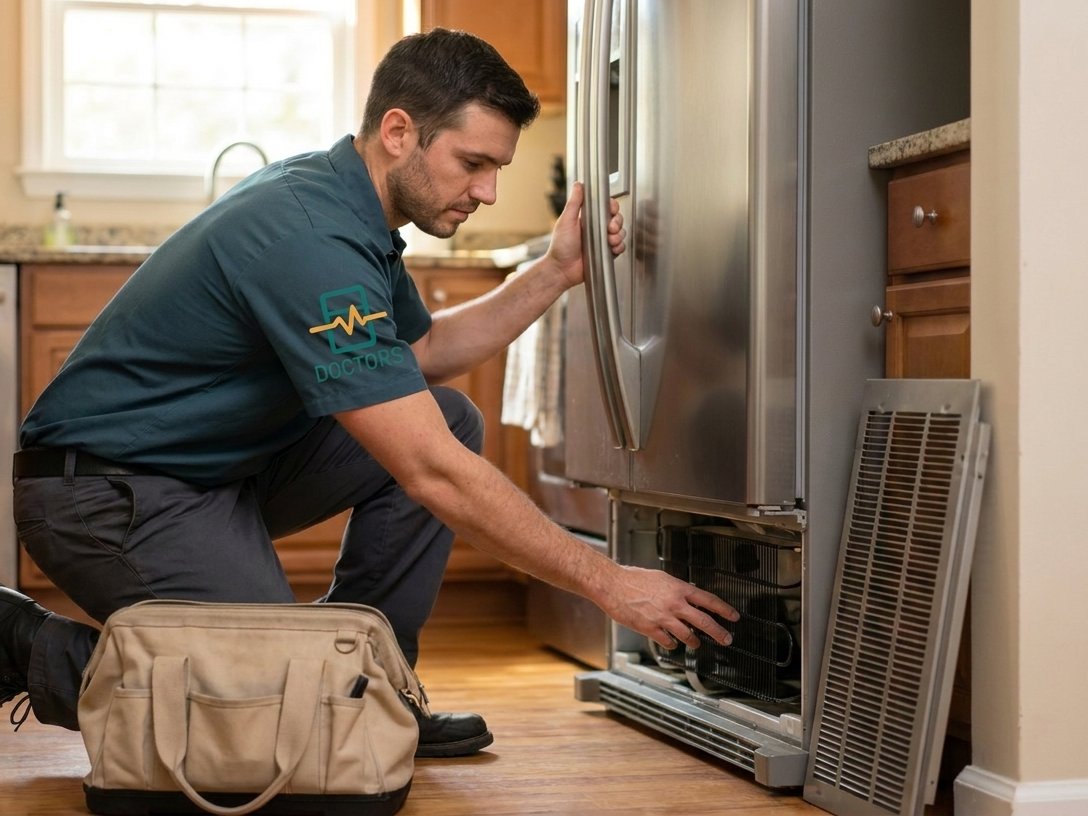
A refrigerator is four systems working together: cooling, airflow, defrost and controls. Guessing at one of them is how people end up replacing a part that was never broken. Our exam covers all four.
1. Temperatures. We measure the real temperature in the fresh-food section and in the freezer, not just what the display says. The gap between them tells us whether the problem is cooling or airflow.
2. Cooling. We listen to the compressor, check that the condenser fan turns, and look at the condenser coil for dust and pet hair. A coil that cannot shed heat makes a healthy compressor look weak.
3. Airflow. We check the evaporator fan and look at the evaporator coil behind the freezer panel. A coil covered in solid frost explains most "warm fridge, cold freezer" calls.
4. Defrost and controls. We test the defrost heater, the defrost thermostat or sensor, and the board or timer that runs the cycle. Then we check the temperature sensors and the main control.
5. Water system, if the model has one: inlet valve, lines, filter housing, ice maker and dispenser.
You get the diagnosis in plain words before any work starts: what failed, why it failed, and what the repair involves. You decide whether to go ahead.
Fans. Evaporator and condenser fan motors wear out with time. A fan that squeals, stops or hits ice is one of the most common refrigerator repairs.
Defrost parts. A new heater, thermostat or sensor brings the defrost cycle back. We melt the built-up frost first, so the refrigerator starts from a clean coil.
Start devices and controls. Start relays, overload protectors, temperature sensors and control boards are all replaceable.
Water parts. Inlet valves, water lines, filter housings and ice maker assemblies.
Door parts. Gaskets, hinges, door closers and the switches that run the light and the fans.
Sealed system. If the compressor or a refrigerant line has failed, our EPA 608 certified technicians handle the refrigerant work. On an older refrigerator we tell you honestly whether that repair makes sense.
Every refrigerator repair uses genuine or OEM-approved parts and carries our warranty of up to 6 months on parts and labor.
We see Samsung, LG, GE, Whirlpool, Frigidaire, Maytag, KitchenAid, Bosch, Kenmore, Electrolux, Amana and Haier refrigerators every week, and our technicians know their weak spots. Appliance Repair Doctors is an independent company and is not affiliated with any appliance manufacturer.
Most refrigerator problems are worth repairing. Fans, defrost parts, start devices, valves, gaskets and boards are replaceable, and one worn part is rarely a reason to retire the whole appliance. The harder call is a failed compressor or a refrigerant leak inside the cabinet walls on an older unit. If that is the diagnosis, we say so plainly and give you the facts to decide.
A refrigerator is never silent, and that confuses people. Part of our exam is sorting normal sounds from symptoms.
If you are not sure which one you hear, record a short video on your phone before the visit. It helps us get to the diagnosis faster.
Many modern refrigerators run a self-test and show a code when something is out of range. Codes differ from brand to brand and even between models, so the same letters can mean different things. In general, codes on refrigerators point to:
A code is a starting point, not a verdict. A fan code can be caused by ice blocking the blade, and a sensor code by a loose connector. We confirm the cause with tests before replacing anything.
The same technician can examine another appliance on the same visit.
Call (470) 570-7920 and describe the symptoms, or send the form, and we will call you back to set a time.
Describe the symptom to us in plain words. Every symptom narrows the search to one system, and that is where our exam begins.
The fresh-food side has no cooling of its own; it borrows cold air from the freezer through a small duct. Frost on the evaporator coil or a stopped fan behind it blocks that air.
The compressor is not being told to run, or it cannot start. Common causes are a failed start relay, a control board fault or a condenser fan that quit.
A dusty condenser, a torn door gasket or a sensor that reads the wrong temperature can keep a refrigerator running for hours without a break.
Defrost water that cannot reach the drain pan, a split supply line behind the fridge, or a dripping valve fitting.
The automatic defrost cycle has stopped. The heater, the defrost thermostat or the board that runs the cycle has failed.
A compressor that keeps trying to start and gives up usually has a bad start device, not a dead compressor.
Somewhere between the wall valve and the ice tray the water stops — see our ice maker page for the full chain.
A damper stuck open or a faulty temperature sensor lets too much freezer air through.
Note the letters and numbers before calling us. Many codes point straight at a sensor or a fan circuit.
Appliance Repair Doctors is a family-owned company. Our office: 4370 Peachtree Rd NE, Brookhaven, GA 30319.
In most of the Atlanta metro we offer same- or next-day visits. Calling (470) 570-7920 in the morning gives you the widest choice of windows.
Usually not. That pattern most often means frost on the evaporator coil, a stopped evaporator fan or a defrost failure. The compressor is running; the cold air just is not getting through.
At or below 40°F in the fresh-food section and 0°F in the freezer. Both numbers come from USDA and FDA food-safety guidance.
Yes. Inlet valves, water lines, filters, ice makers and dispensers are part of our refrigerator work.
Yes. Refrigerator work is covered for up to 6 months on parts and labor.
No. Appliance Repair Doctors is an independent, family-owned company. Brand names on this page only describe the refrigerators we repair.
It depends on where it comes from. A buzz with no ice can be the water valve; a growing fan noise often means a fan touching frost. A short video helps us sort it out.
Freezer Repair Ice Maker Repair Oven Repair Refrigerator Repair Stove & Range Repair Wine Cooler Repair
Call Appliance Repair Doctors: (470) 570-7920
Call the Doctors — (470) 570-7920 Or request a callback