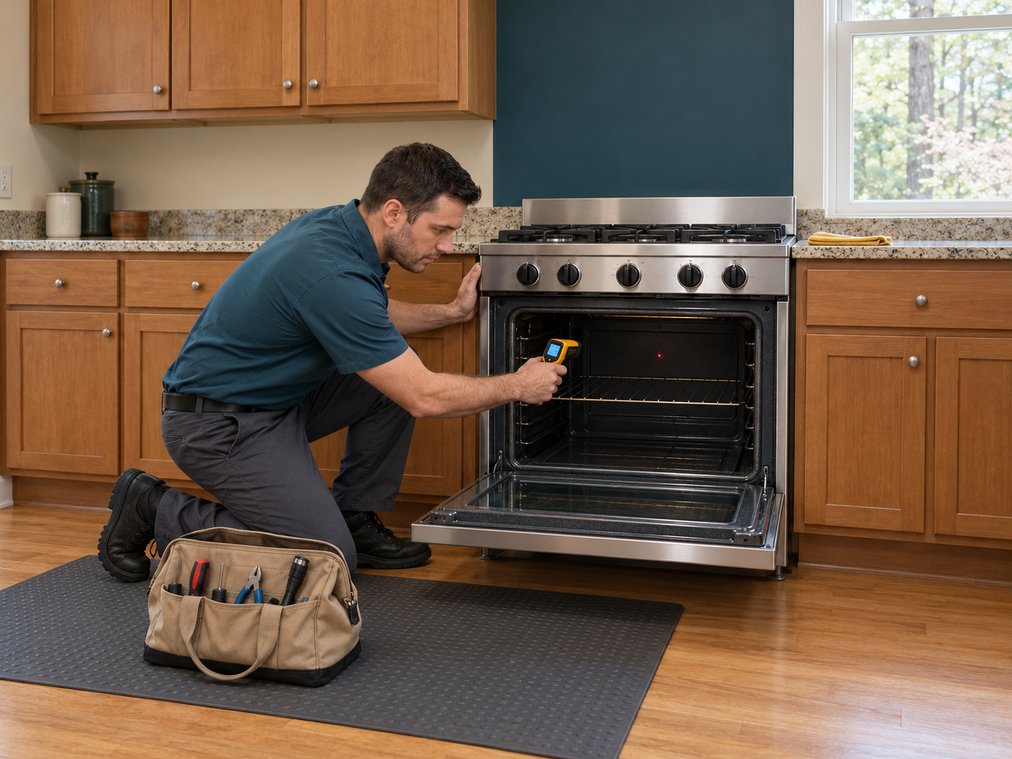
An oven that will not heat is easy to notice. An oven that runs 30 degrees cool is harder: the cookies burn on the bottom, the roast takes an hour longer, and you start blaming the recipe. Appliance Repair Doctors test the oven the way a doctor tests a patient — with measurements, not guesses — and repair the part that is actually failing. Our oven house calls cover Atlanta and the towns around it.
Call (470) 570-7920 or send the form on this page. Tell us whether the oven is gas or electric, the brand, and what it is doing.
Choose the appliance, then enter a 5-digit ZIP code to see if we come to your area.
Choose your appliance to see how the Doctors diagnose and repair it.
Not cooling, leaking water, ice maker down or a strange noise.
Frost buildup, food softening or a freezer that runs nonstop.
No ice, slow ice or a leak from the dispenser.
Wine coolers and beverage centers that run warm.
Gas and electric ovens that will not heat or bake evenly.
Burners, cooktops and ranges: gas, electric and induction.
1. Measured temperature. We run the oven and measure its actual temperature with our own thermometer, then compare it with the setting.
2. Heat sources. On electric ovens we test the bake and broil elements. On gas ovens we check the igniter, the gas valve and the flame.
3. Sensors and safety parts. We test the temperature sensor and the thermal fuse or limit switch that cuts power when the oven overheats.
4. Controls. We check the relays and signals from the control board, the selector and the display.
5. Door, hinges and gasket. A door that does not close tight lets heat escape and makes the oven run cool.
6. Convection and cooling fans, on models that have them.
After the exam you get a plain explanation and the repair plan before we start.
Brands we service include GE, Whirlpool, Frigidaire, KitchenAid, Samsung, LG, Bosch, Maytag, Electrolux, Thermador, Wolf, Viking and others. We are independent and not affiliated with any oven manufacturer.
Every oven repair uses genuine or OEM-approved parts and carries our warranty of up to 6 months on parts and labor.
Most oven repairs — elements, igniters, sensors, switches, door locks — are worth doing. A wall oven is built into your cabinets, so replacing it can mean changes to the cabinetry. A control board on an older oven is the main case where we discuss the alternatives, and we do that with the diagnosis in hand.
Gas ovens heat with a burner under the floor of the oven. A hot-surface igniter glows until it is hot enough to open the gas valve, and the burner lights. Over time the igniter weakens. It still glows, but the valve opens late or not at all. That is why "my gas oven takes forever to heat" is one of the most common calls we get. Gas ovens can also have a separate broil burner with its own igniter.
Electric ovens rely on two main heaters: a bake element along the floor of the cavity and a broil element in the ceiling. Many also have a convection element and fan at the back. An element can burn out with a visible blister or split, or it can fail without any visible mark. The control board switches the elements on and off through relays, and a failed relay looks just like a failed element from the outside — which is why we test before we replace.
Dual-fuel ranges pair a gas cooktop with an electric oven, so the oven side is repaired like an electric oven.
Self-cleaning heats the oven far above cooking temperature to burn off soil. It is hard on parts. Problems that often show up after a self-clean cycle:
If your oven acted up right after self-clean, mention it. It narrows the diagnosis.
A wall oven is mounted in your cabinets. To reach the wiring or some parts, the oven may need to slide out of the opening. Our technicians do this with care for the cabinetry and the trim, and we put everything back the way we found it.
Call (470) 570-7920 and describe what your oven is doing, or send the form and we will call you back to set a time.
On an electric oven: a burned-out bake element, a failed relay on the control board or a blown thermal fuse. On a gas oven: a weak igniter, a failed gas valve or a control fault.
A gas igniter that glows but is too weak to open the valve fully, or one of two electric elements has failed.
A temperature sensor out of range, a control that needs calibration or a door that leaks heat.
The broil element is not helping during bake, or the convection fan has stopped.
A failed broil element, igniter or switch.
Many codes point to a sensor, a door lock or a control circuit. Write the code down before calling.
The lock motor, the lock switch or the control is holding it.
A worn fan motor or a broken blade.
A control board, a power supply or the wiring behind the panel.
Office: 4370 Peachtree Rd NE, Brookhaven, GA 30319.
Most often the igniter is weak. It glows, but not hot enough to open the gas valve fully, so the burner lights late or not at all.
Usually the bake element. We confirm it with a test before replacing it.
Yes. We measure the real temperature, test the sensor and adjust or repair the control as needed.
Yes, single and double wall ovens, gas and electric.
Yes. Oven repairs carry our warranty of up to 6 months on parts and labor.
Self-clean heat can blow a thermal fuse, burn out an element or damage a lock or control. We test each one.
Usually, but food may cook unevenly. If you smell gas or burning wire, stop using it and call.
Yes. Each oven has its own elements or burners and sensors, and often its own control circuits.
Freezer Repair Ice Maker Repair Oven Repair Refrigerator Repair Stove & Range Repair Wine Cooler Repair
Call Appliance Repair Doctors: (470) 570-7920
Call the Doctors — (470) 570-7920 Or request a callback